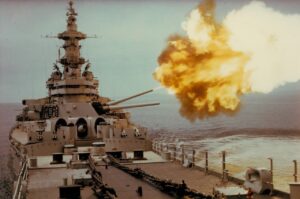


Two merging lows, hard upwind sailing, and a remarkable welcome in China’s Olympic sailing city.
Nǐ hǎo (你好).
That’s one of the first phrases I learned arriving in China. Pronounced something like “nee-how,” it simply means hello. Two short syllables, but they carry a lot of warmth. I’ve heard it from hotel clerks, shopkeepers, and people passing on the street. It’s a small phrase that opens a door.
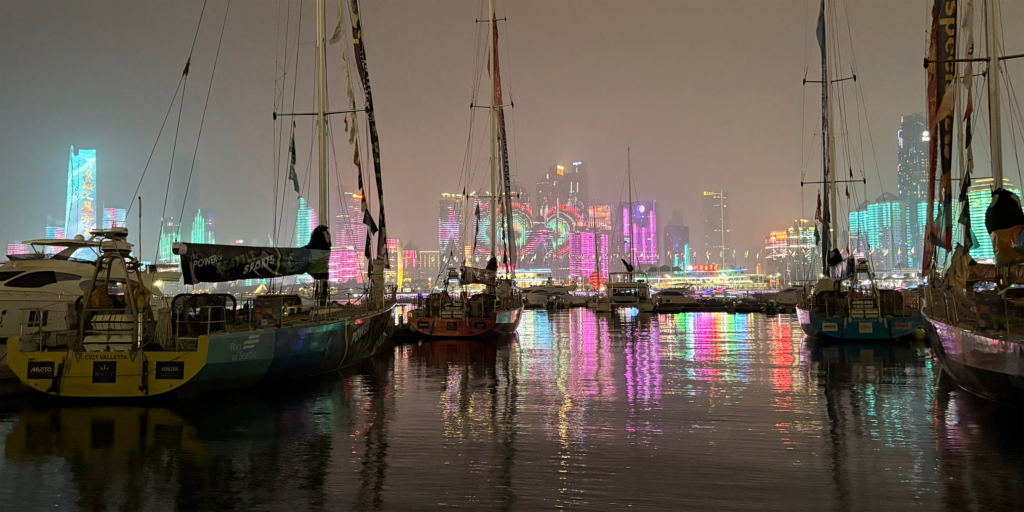
And I’ll come back to China in a moment, because I’m enjoying my time here more than I expected.
But first—the race.
A Race of Extremes
The second race of Leg 5, from Subic Bay in the Philippines to Qingdao, China, was a race of contrasts.
We began in the most unlikely way for a sailing race—under engine. The wind near Subic Bay had collapsed into a large wind hole, and rather than drift aimlessly before the start, the fleet motored out to the start line looking for breeze.
The race began with a Le Mans start where we line up offshore and all begin from the same point on the open ocean. The tone was set quickly that this would not be an easy, fast downwind run.

It was mostly beating upwind—sailing as close to the wind as the boat allows and tacking back and forth across the sea. It’s slower work, more physical, and demands constant trimming and attention. The boat heels hard, spray comes over the bow, and every maneuver costs effort.
We did manage to fly our spinnaker—our “kite” a few times, those big sails designed to pull the boat along when the wind is behind us. But those moments were brief. Most of this race was fought the old-fashioned way—nose into the wind.
As we pushed north toward China, the weather added another layer of challenge. We sailed through two low-pressure systems that were merging together, which kept the wind shifting and the seas unsettled. It made for a restless stretch of sailing—constantly adjusting sails, trimming for new angles, and keeping a careful eye on what the weather was about to do next.
The Approach to China
As we closed on the Chinese coast, a new challenge appeared on the horizon.
The Chinese fishing fleets.
They don’t appear as a few scattered boats. Instead they form dense pockets of activity—dozens of vessels working the same area, often surrounded by buoys, nets, and gear in the water. On radar and AIS they look like glowing clusters, and visually they can feel like sailing toward a floating city.
Threading our way through those fields kept us on our toes. A racing yacht moving quickly through a maze of fishing gear is something we very much wanted to avoid.
Every watch on deck had the same focus: eyes outside the boat, scanning for lights, markers, and movement.
From Exhaustion to Exhilaration
If the final run into Subic Bay had dragged almost everything out of me, the run north to Qingdao had the opposite effect.
It was exhilarating.
The boat felt alive again, the crew was sharp, and there is something energizing about sailing toward a new country and a new culture.
By the time we crossed the finish line, the fatigue that marked the end of the previous race had been replaced with something closer to excitement.
Hello, China
And that brings me back to “Nǐ hǎo.”
I’m very much enjoying China.
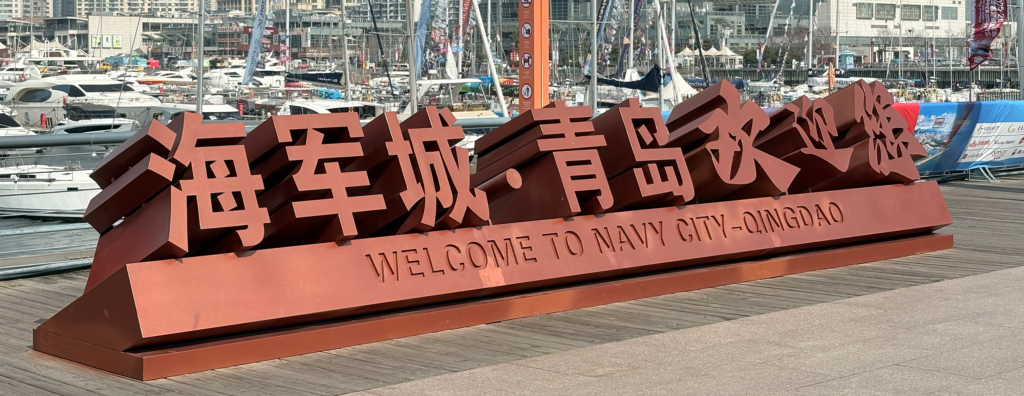
Qingdao is clean, organized, and surprisingly calm for a large city. The people I’ve met have been friendly, polite, and respectful. Even with the language barrier, there’s a sense of welcome that comes through in smiles, small gestures, and patient attempts to help a wandering sailor find his way. Our arrival ceremony and prize giving were easily the most elaborate we have experienced yet. Xièxiè to the city of Qingdao. Xièxiè means “thank you” in Mandarin Chinese, and it is pronounced roughly “shyeh-shyeh.”
Qingdao also has a special place in China’s sailing world. The city hosted the sailing events for the 2008 Beijing Olympics, and the marina and sailing center built for those games are still very active today. It’s become something of a hub for sailing in China, hosting international regattas and welcoming visiting fleets like ours. Arriving here by boat, you can feel that connection—the harbor is full of masts, sailing schools, and boats out training on the water.
A big part of that welcome comes from the local volunteers assigned to each boat. Ours is Julia, and she has been incredible. She helps with everything from finding shops for things we need to translating when we are trying to talk with locals.
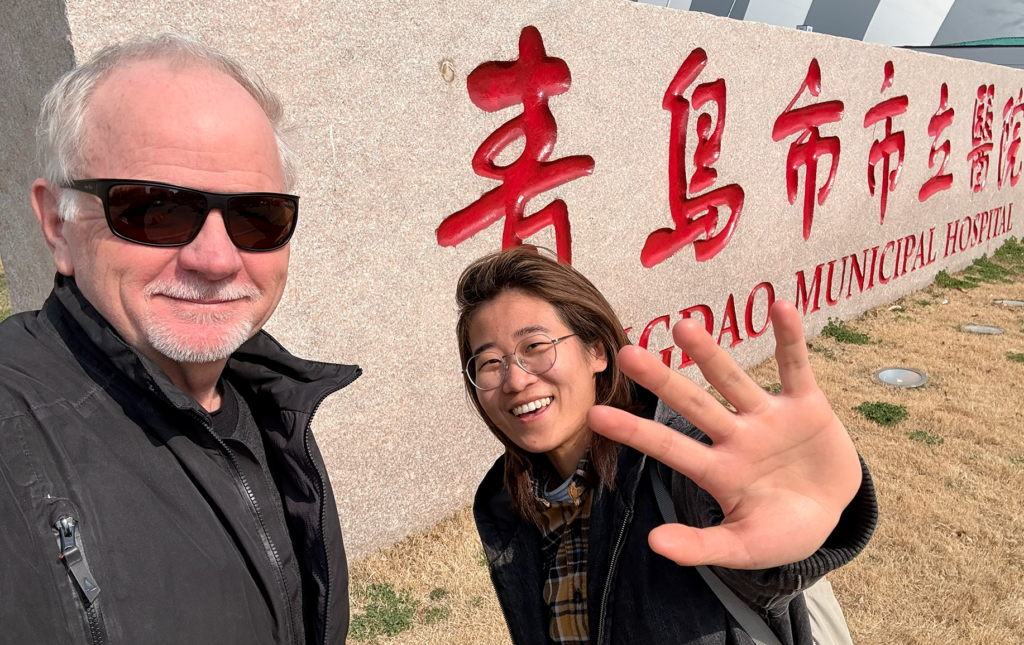
For me in particular, I have a nagging knee injury. It’s nothing serious, but with a Pacific crossing ahead I wanted to have it looked at. Julia helped me get an appointment at the hospital and stayed with me through the appointments to help translate and make sure everything went smoothly.
What amazed me even more was how quickly everything happened. I was able to see a doctor the same day, had both an X-ray and an MRI done within a few hours, and was set up with three physical therapy sessions. The uninsured cost for all of this came to around $100 USD.
I was also surprised to see that much of the equipment in the hospital carried familiar names. Brands like Philips and Dell were everywhere, a small reminder that even halfway around the world, some things look surprisingly familiar.
Traveling like this—arriving by sea—gives you a different perspective on a place.
If I were a younger man, I suspect I would spend more time here exploring. China is vast, complex, and fascinating, and it feels like a place where every train ride could take you somewhere completely new.
Looking Ahead to Korea
Our next stop is Tongyeong, South Korea.
When we arrive, I’ll be hopping on a train to go see my son Dylan and Belinda, his fiancée. One of the unexpected gifts of this race has been the way it occasionally intersects with family, and I’m really looking forward to that moment.
There’s something special about crossing oceans and then stepping onto a train platform to see someone you love waiting there.
A Hard Moment in Qingdao
There’s one more thing on my mind as we prepare to leave Qingdao.
My friend Susan, who sails on another Clipper boat, took a fall in the last race—similar to the one I took earlier. Unfortunately, her injury is more serious. She is one of the best people I’ve met during this entire Clipper experience. Kind, upbeat, and the sort of person who makes everyone around her feel better just by being there.
A few days ago I saw her in tears—partly from the pain, but also from the realization that she won’t be leaving Qingdao on her boat with the rest of the fleet. That moment broke my heart. Susan, if you read this: I’m sending you love. You’re my hug buddy, and the race won’t feel quite the same without you out there.
Until the Next Horizon
Soon enough we’ll cast off again, point the bow toward Korea, and trade city lights for stars over the open ocean.
But before we leave, I’ll say it one more time:
Nǐ hǎo (你好) China, Xièxiè (谢谢), and Zàijiàn (再见).