

How the 1983 America’s Cup taught me—four decades and three ocean crossings later—what pressure really costs
I grew up loving the America’s Cup.
Not casually. Devotionally.
The America’s Cup is the oldest continuously contested sporting trophy in the world, and for most of its life it lived in the United States. One hundred and thirty-two years of uninterrupted victories — the longest winning streak in sports history — does that to you. It stops feeling like a competition and starts feeling like gravity.
Ted Turner was my guy. The confidence. The audacity. The belief that the Cup didn’t just belong in the United States — it was the United States.
Then came 1983.
I was away in boot camp but remember reading about Liberty and Dennis Conner in that final race, throwing tack after tack at Australia II. Nearly fifty tacks on the last leg — one every minute to a minute and a half for almost an hour. I could tell something extraordinary was happening. I just didn’t yet understand what it cost.
When the Cup was lost, I was heartbroken — but also distracted. I was in the Navy. There were watches to stand, qualifications to earn, oceans to cross. The loss stung, but steel decks and long nights at sea have a way of pushing yesterday’s headlines into the background.
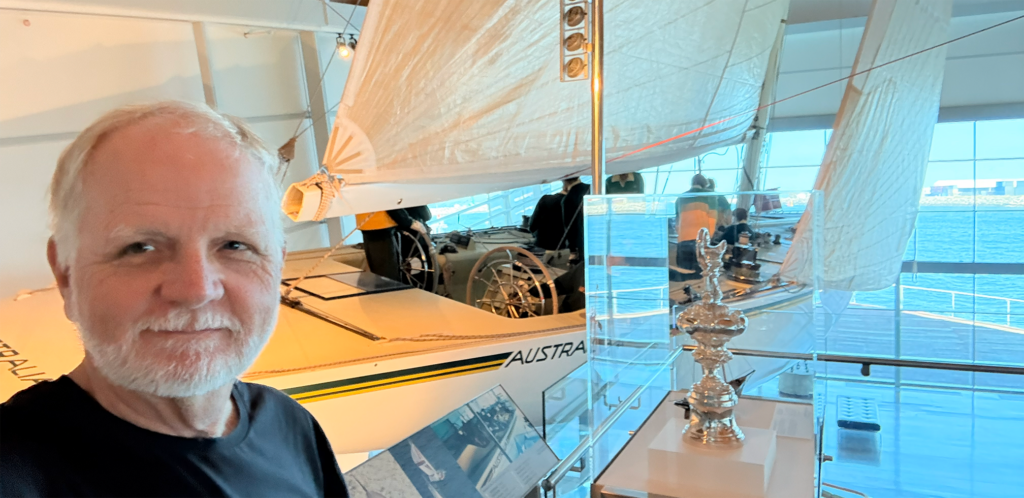
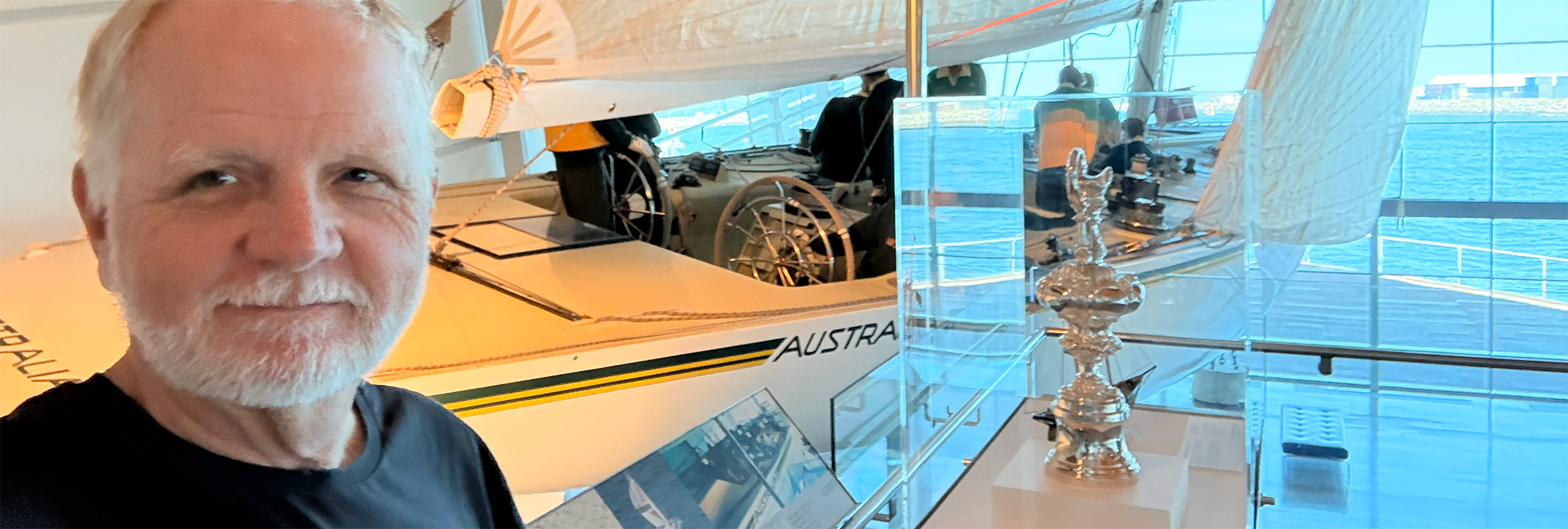
Today, I’m sitting in the Western Australian Maritime Museum, right next to Australia II and her winged keel.
Up close, the keel isn’t mysterious. It’s just fiberglass and geometry. What is overwhelming is what it represents: preparation, innovation, and the discipline to execute under pressure. Looking at it now, I don’t feel resentment. I feel respect.
Because now, I finally understand that last leg.

I’m racing around the world in the Clipper Race, and I’ve stood at the helm tired enough that the compass numbers blur together. I have been on the yankee sheet grinder during a tack knowing that my actions directly affect the movement of the boat. I know what it costs to tack once — the loss of speed, the hesitation as the boat finds her groove again, the crew scrambling to grind sails back in. A tack is the act of turning the bow through the wind to change sides, and it always costs speed — sails luff, momentum bleeds away, and the boat must fight to come around and get back up to speed. Do it once and it’s manageable; do it every minute and the losses compound fast. I know how much mental energy it takes to stay sharp when your body wants to go off watch and disappear into a bunk.
Dennis Conner’s fifty tacks was not theatrics. Not panic. When you’re behind, you don’t get to sail conservatively. You trade time and energy for possibility. You hope the leader blinks. You hope for one missed call, one bad acceleration, one small mistake.
And John Bertrand didn’t blink.
Australia II matched almost every tack. One every minute or so. Over and over. That rhythm matters. It compounds fatigue. It rewards the boat that accelerates cleanly and punishes the one forced to initiate. Bertrand didn’t need to win that leg — he just needed to refuse to lose it.
That’s match racing at its purest.
And its cruelest.
Sitting beside Australia II now, as a sailor instead of just a fan, I see that the Cup wasn’t lost in the final 41 seconds at the finish line. It was lost one minute at a time — tack by tack, decision by decision — over nearly an hour of relentless pressure.
I still feel the ache of that loss. It marked the end of an era I believed was permanent.
But after thousands of miles at sea, I understand something I couldn’t back then: the Cup didn’t leave because America failed. It left because someone else sailed better when it mattered most.
From a kid watching the Cup, to a sailor standing watch offshore, to a man sitting beside the keel that changed everything — I now know that oceans, and history, are won one hard minute at a time.
I’m learning that lesson again, mile by mile, as we race around the world in the Clipper Race — where nothing is given, and every minute still matters.