
From a perfect race unraveling at sea to a fleeting reunion on land—heartbreak, perspective, and the long road home across the Pacific
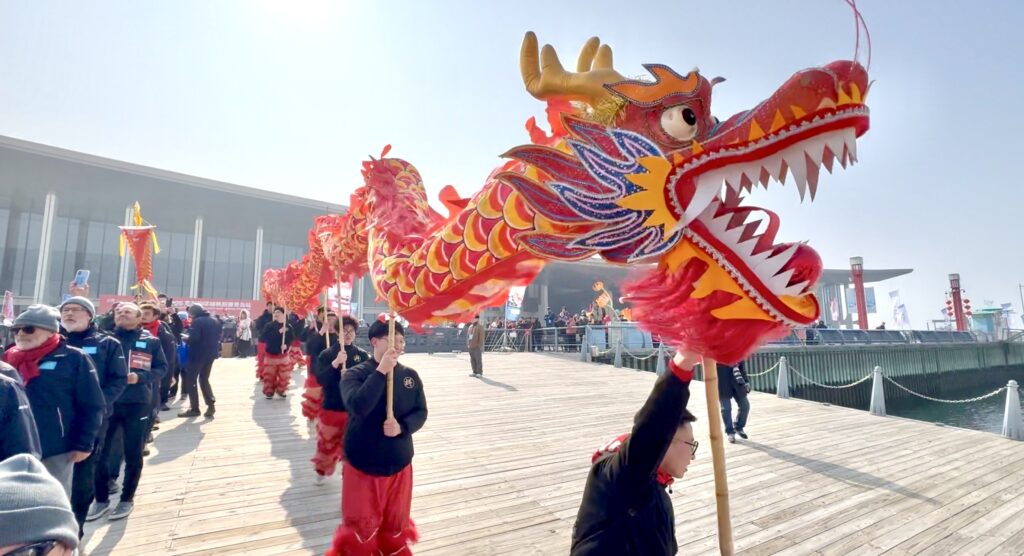
Qingdao didn’t just send us off—it celebrated our departure. The dock was alive with an elaborate ceremony, music, flags, and a crowd that seemed genuinely invested in our journey. Among them was Julia, our tireless local volunteer, whom we spotted again and again along the dock, waving and wishing us well as we slipped lines. At one point she ran over to me and pressed a small gift into my hand—a whistle she had 3D printed herself. We had talked about so many things during our time in Qingdao, but I don’t think I ever mentioned my own passion for 3D printing. Somehow, she found her way right to it anyway. That little whistle instantly became one of my most cherished items from the race—a parting gift from a new friend. Thank you, Julia!
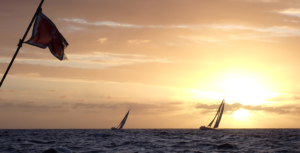
We left Qingdao under gray skies and light air, motoring out past the chaos of fishing fleets to set up for a Le Mans start. It’s a strange way to begin a race—engines humming, sails limp, and a fleet of identical boats waiting for just enough wind to turn a motor parade into a sailing contest.
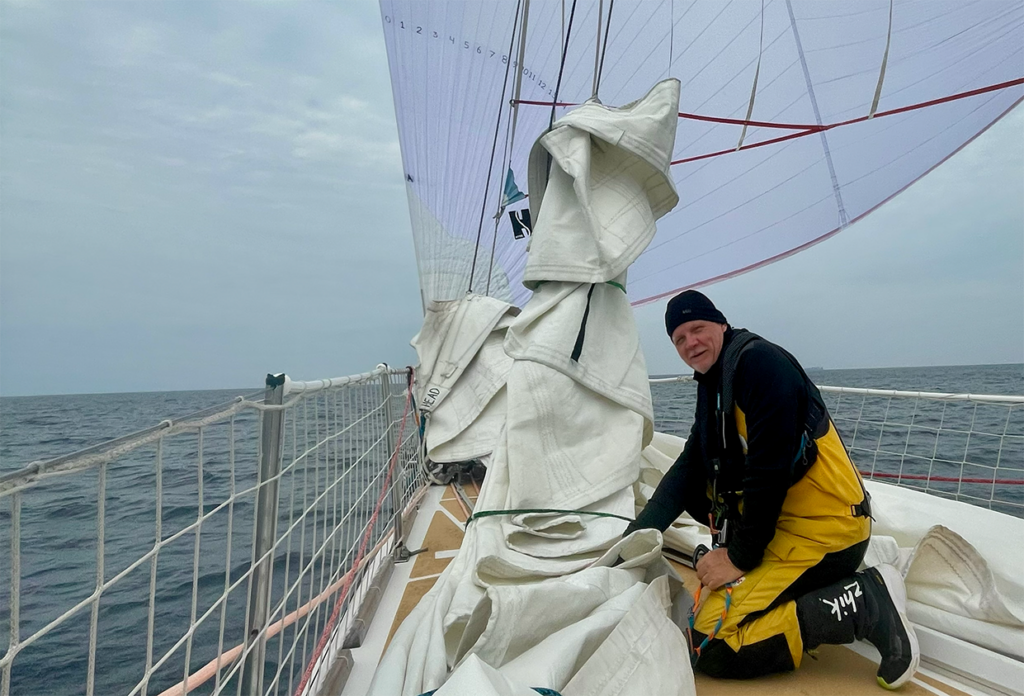
And yet, even in those uncertain conditions, we showed our hand early.
Fast Starts, False Starts
In both of the first two race attempts, we were right where you want to be—near the front of the fleet, moving well, feeling sharp. On the second attempt, we weren’t just near the front—we were the front, sailing clean and fast while a cluster of boats behind us sat trapped in wind holes.
But the race committee saw what we couldn’t fully appreciate from our vantage point: too much of the fleet stalled, too little fairness in the conditions.
Race abandoned.
Again.
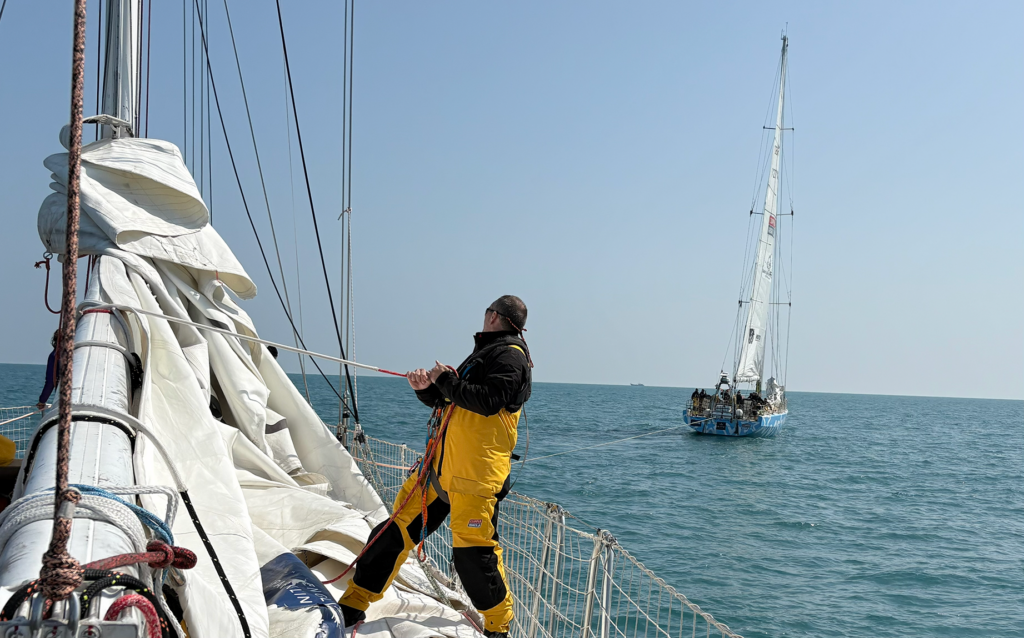
Between those two attempts, déjà vu struck. Somewhere beneath us, something wrapped the prop—an unwelcome echo of our race from Spain to Uruguay. It meant that for race start number three, we didn’t even have the luxury of positioning ourselves.
Two different boats, GOSH and Scotland helped by towing us to the start line. Without the momentum built during a Le Mans start we crossed dead last.
The Climb
There’s a certain clarity that comes from starting at the back. No illusions. No strategy except one: go.
And go we did.
We sailed hard—harder than I think we ever have. The teamwork was dialed in, the calls were sharp, the trimming relentless. Bit by bit, boat by boat, we clawed our way forward through the fleet.
The wind favored us. The boat felt alive.
We were back in it.
When Luck Turns
Then the tide shifted—not the water, but fortune.
Threading our way through a dense fishing fleet, one boat made a move that still sits uneasily with all of us. It crossed our bow and dropped a buoy with a trailing line. Whether intentional or not, the result was the same: the line wrapped under the boat. The drag was immediate. The frustration, instant. For the second time this race we snagged something. Ugh. We cut it free and pushed on.
The Move
By the time we approached the virtual mark—the turn north—we had fought our way into contention. One boat ahead. One closing from behind.
This is where races are won.
We edged up on the windward side of the leader, stole their wind, and then—just feet off their beam—blew past them under our massive Code 1 spinnaker. It was one of those moments where everything clicks.
We executed a flawless no-wind gybe.
And then the boat lit up.
11 knots.
12 knots.
A burst to 13.
We were flying.
The Perfect Drop
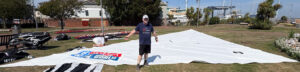
We prepared for the kite drop—transitioning from full power to upwind sails. My role: teddy bear.
A letterbox drop is not just about getting the sail down—it’s about controlling energy and keeping everyone and everything safe, including the sail itself.
A retrieval line is attached to the tack of the sail, run over the boom, and fed across the boat through a block and to the companionway. When the tack is released, that zig zagging line becomes the primary way we pull the sail into the boat and down below.
But the sail doesn’t want to come quietly and that’s where the teddy bear comes in.
I stand on the cabin top, physically wedged between the boom and the vang. The vang is a line that controls the shape of the mainsail. It crosses through several blocks from the base of the mast up to the boom and it’s super tight when we are powered up. It gives me a web of firm lines to lean against as I do my kite drop job.
So when the kite is coming down, it threads over the boom and straight through my outstretched arms. My job is to compress it—force it into tight folds and prevent any air from getting back into it. Because if it fills again, even partially, it can generate enough force to rip the sail back out, overpower the crew on the line, or pull someone off the deck and into the water. So the job is simple in theory: kill the air and control the sail. In practice, it’s a wrestling match with a living thing.
As I waited in position, I had a clear view aft and I witnessed something that at the time lifted our spirits. The two boats behind us were falling further and further back. What we didn’t know then is that those two would eventually be on the podium without us.
Then came the call—“Blow the Tack!”
The tack released… or at least it was supposed to, but nothing happened. We all just looked at each other—confused. In that moment, with the sail fully powered and loaded, a failed release is one of the more dangerous scenarios you can have. Adding to my uneasiness is that with us overpowered the boat was heeling more and more until the boom was skimming the water. And what crossed my mind is how we depower the mainsail quickly by releasing the vang. That means the very line I was bracing against would suddenly go limp and let go of me.
Thankfully and suddenly the tack released, the retrieval line loaded up, and the sail came across the boom exactly as planned. It fed through my arms in heavy, snapping folds and stayed contained. It felt like one of the cleanest drops we’ve done.
At the time, the delay of the tack releasing just felt like a slightly messy start to an otherwise perfect maneuver. Later, we learned what really happened. The trip line had snapped leaving the mechanism to release the sail inoperable.
We still don’t know exactly how the sail finally released—but we do know this: if it hadn’t, that sail would have stayed loaded. And under the pressure of increasing wind, something would give. Best case, we shred the sail. Worst case, someone gets hurt. In a race full of bad luck, that was the moment we realized it could have been a whole lot worse.
With the kite finally down we raised yankee and staysail. Even through the sail change, we extended our lead.
We were in command.
I went off watch with the boat charging at well over 11 knots, convinced we were sailing into a podium—likely even a commanding win.
The Feel of the Slowdown
It wasn’t to be. Four hours later, when I came back on deck we were in third place with a boat overtaking us on our starboard beam.
Something was wrong. I rotated in to “check helm” behind one of our best helmsmen and could see and feel something wasn’t right.
The check helm role is a quiet amplifier of performance. It allows the helmsman to steer without having to look away from the sails or horizon to read the compass or instruments. The check helm feeds them a data stream like:
- “Compass 040, speed 9.5 knots, on course”
- “You’re bearing away, come back up”
- “Wind shift, come up 5 degrees”
It becomes a rhythm. A feedback loop firing every few seconds that lets the helmsman anticipate rather than react.
But this time, the numbers didn’t make sense. The speed was capped at 9.5 knots and the helm felt wrong—squirrelly. Not just hard or light, but unpredictable. The bow would suddenly get pulled off course like something below us had a grip on the boat.
We trimmed relentlessly. Squeezed every angle. Shifted weight.
Nothing.
When I took the helm it was the same 9.5 knot ceiling and same wobbly feeling. After 25,000 nautical miles on this boat, we know her language. This wasn’t wind, waves, or current.
We were dragging something again.
The Final Minutes
Near the end of my time on the helm I caught a green light in the corner of my eye.
Another boat.
Closing.
I learned later they had issues with their sails so neither of us could break much more than 9.5 knots. But they were higher.
The race was set to end at 2:00 AM.
At 0155, our calculations had them 0.33 nautical miles behind us relative to the virtual finish line.
At 0200…
0.01 nautical miles ahead.
Fifth place.
Heartbreak.
After the Finish
We had to be towed into Tongyeong, thanks to the UNICEF and Punta boats for the tow. This wasn’t the finish we expected a day earlier but it is the one we had. When a diver went under the boat they didn’t find anything on keel, prop, or rudders. All I can do is shrug.
But the Clipper experience gives you more than race results. That night, walking into dinner, I passed my friend Heidi—someone I had met back in England what feels like a lifetime ago.
She told me she had been on the helm when they started to overtake us. I smiled and said I had been on our helm at the same moment.
Two friends. Half a year later. Half a world away from meeting, passing in the dark on the open ocean.
That’s the Clipper Race.
Bad luck and heartbreak, yes. But also the company of great people from all over the world.
Prizegiving
The Tongyeong community celebrated our stopover with an elaborate prize giving ceremony. We applauded those who stood on the podium with genuine respect. There were awards to celebrate the arrival of all the boats.
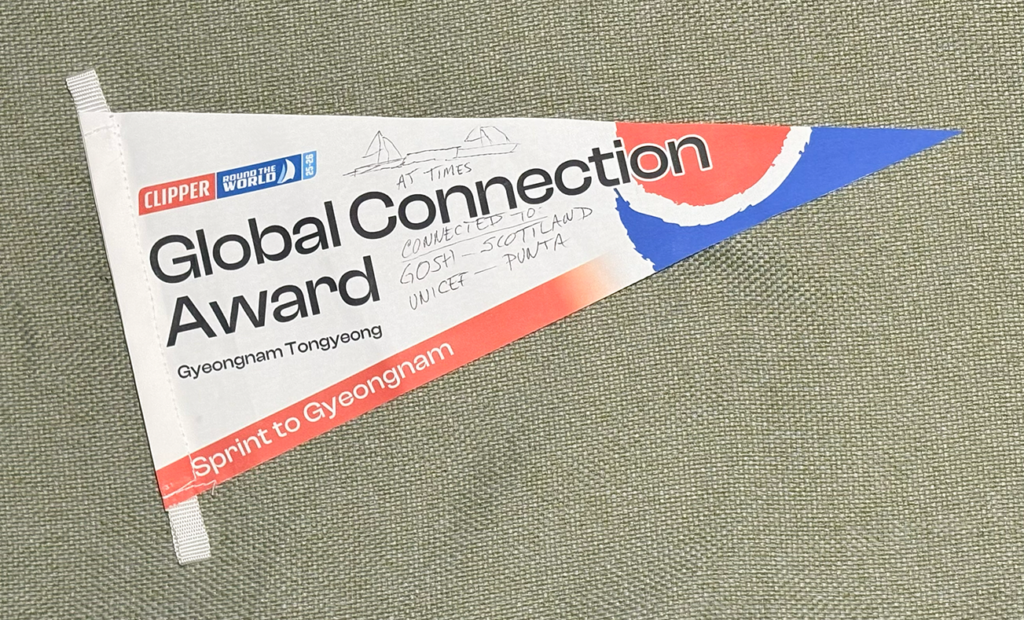
Our “Global Connection Award” was to celebrate the Tongyeong to Seattle connection the race created. I found the irony in that through this race were connected by tow line to the boats branded GOSH, Scotland, UNICEF, and Punta. So I guess, in a way, it’s the perfect award to close out the disappointing but memorable race.
Family
After everything the race had thrown at us, I found something I didn’t even realize how much I needed—time with family. I hadn’t seen any of them since Cape Town, and I hadn’t seen my kids at all since leaving the U.S. last August. By chance and a bit of determination, my oldest son was in Seoul with his fiancé while we were in Tongyeong. They took a day to meet me in Gyeongju.

My crew mate Valerie came with me, and between a two-hour taxi ride and a run north on the high-speed train, we made it happen. My son spent hours traveling south to meet us. We shared a meal, walked the town, and packed a lifetime of emotion into just a few precious hours. Seeing him filled my heart in a way that’s hard to put into words—it reset me, recharged me, and reminded me why this journey matters. My gratitude—for family, for friends, for moments like that—is immense.
Next up: Crossing the Pacific
Next comes the Pacific. A long, cold crossing to Seattle, where the miles will stretch and the seas will likely test us in new ways. It won’t be easy—nothing out there ever is—but this time the horizon holds something deeply personal. On the far side of that ocean is my wife, and my first step back onto U.S. soil since leaving last August. That thought carries weight. It sharpens the purpose. Through whatever the Pacific throws at us, I’ll be sailing toward home.