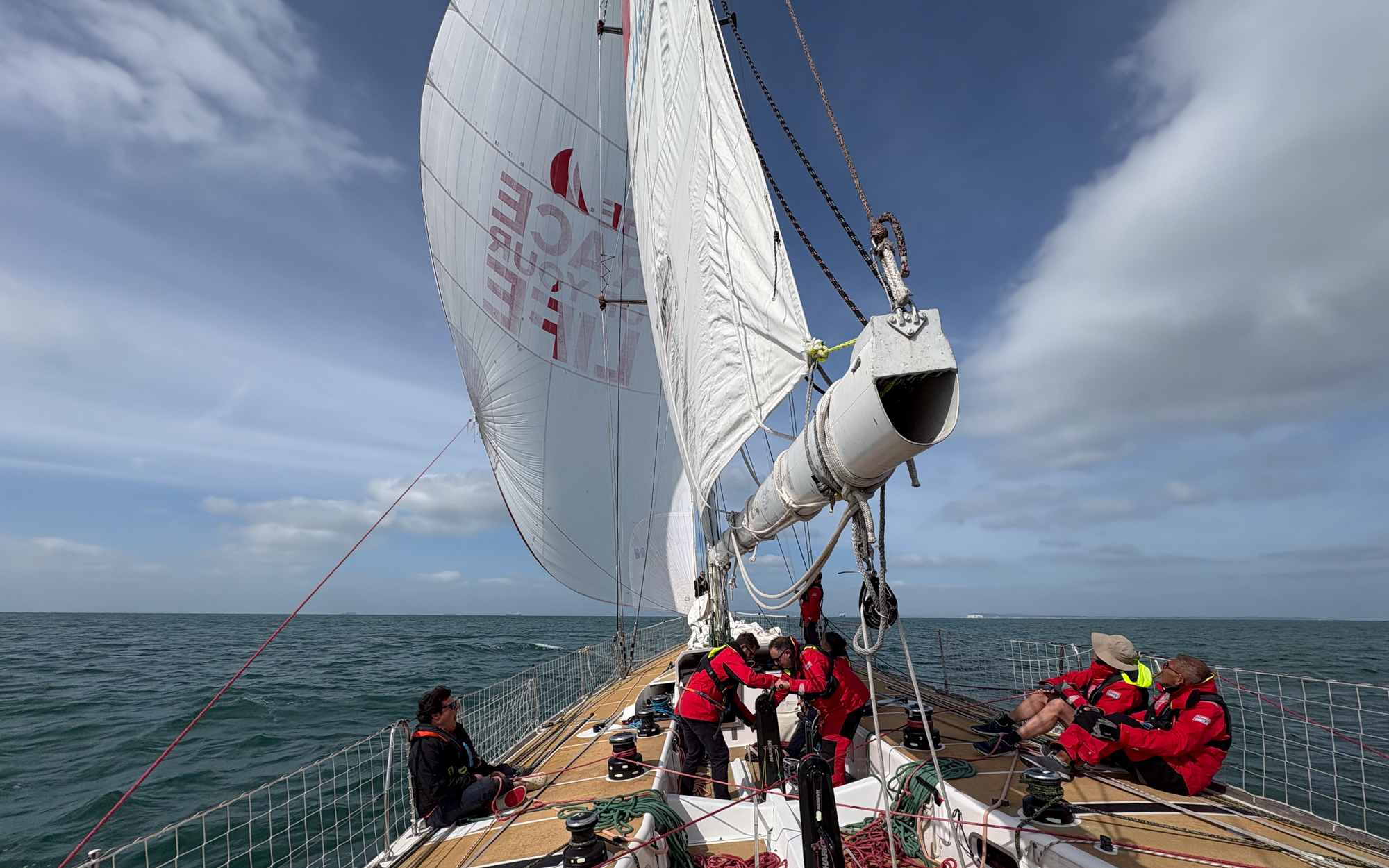

From rookie drills to racing with my future team, this is how Clipper turned me from a sailor-in-theory into a sailor-in-training.
Level 1: Finding My Sea Legs
“This is where it all started. No experience was required—just a willingness to learn and a sense of adventure.”
Though I had been to sea before—in the Navy—I had almost no sailing experience when I signed up to circumnavigate on the Clipper Race. That didn’t matter. Clipper’s training is designed for people like me: eager, green, and ready to be humbled by a ocean racing yacht. It all started on Level 1 training in Gosport, UK.
Our training boat was branded Courageous, echoing Ted Turner’s iconic 1977 America’s Cup winner. And while none of us were racing legends, we shared something just as valuable—a common goal. About 90% of the crew were like-minded and positive, open to learning and embracing the camaraderie that life at sea demands. Level 1 was also the opportunity for the other 10% to decide it wasn’t for them.
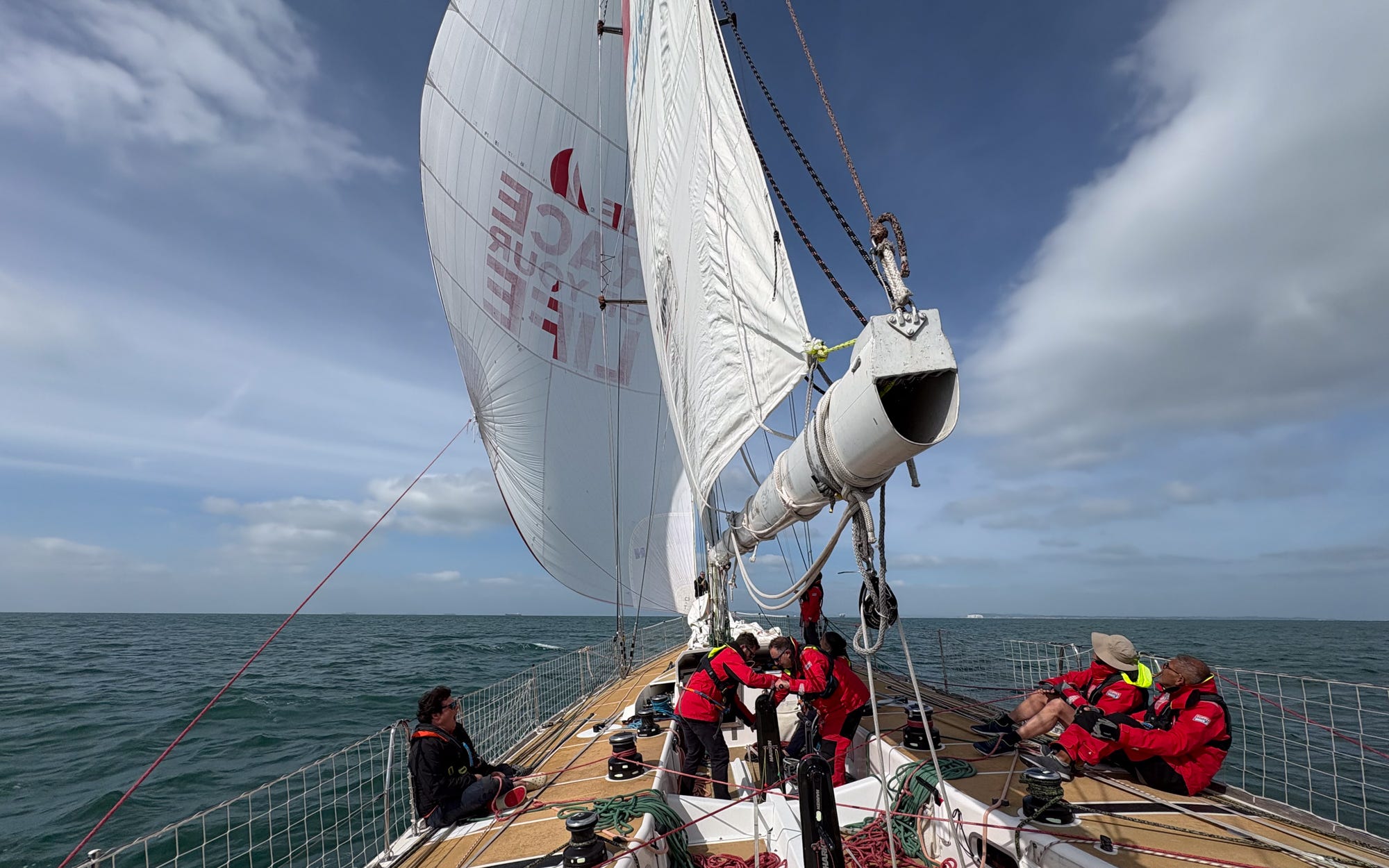
I stepped onboard with knots in my stomach. The learning curve was steep. We started with the basics—knot tying, terminology, life aboard. But quickly it escalated to the physical: learning how to move around the boat safely, how to grind a winch under load, and how to haul sails as a team. Drill after drill after drill—hoisting sails, dropping them, tackathons where we tacked again and again—each repetition built confidence and muscle memory. We drilled safety, when to clip on and how to stay out of the danger zones like the CCZ.
Then came that moment. The first time the boat truly heeled over under full sail—no engine, just wind in sail—it was unforgettable. The boat came alive beneath our feet, and for the first time, we were really sailing.
Level 2: Building Seamanship
“Night sailing, more navigation, more responsibility.”
Level 2 felt different from the start—not just in the skills we were learning, but in the chemistry of the crew. Day one of this class is the official RYA Sea Survival course, a day in a pool learning critical skills we hope to never need. They taught vitally important concepts like:
- Keep the water on the outside of the boat
- Always step up into a life raft
From the pool we moved to the boat and this was the best training team I sailed with yet, and the six people on my watch were, without question, the best group I’ve ever been part of. We clicked right away, laughed for six days straight, and that made all the difference.
When I got a little seasick early on, they didn’t hesitate—they closed ranks around me, made sure I stayed fed and hydrated, and carried the weight until I was back on my feet. That kind of care and trust builds fast offshore.
This was the first training leg where we stayed out for days at a time, learning to live in the rhythm of the sea. We stood watch and drilled tacking and gybing relentlessly, learning to move together with precision and timing. For the first real time since my Navy days, I was offshore at night with nothing but the stars overhead and the hum of wind and water around us.
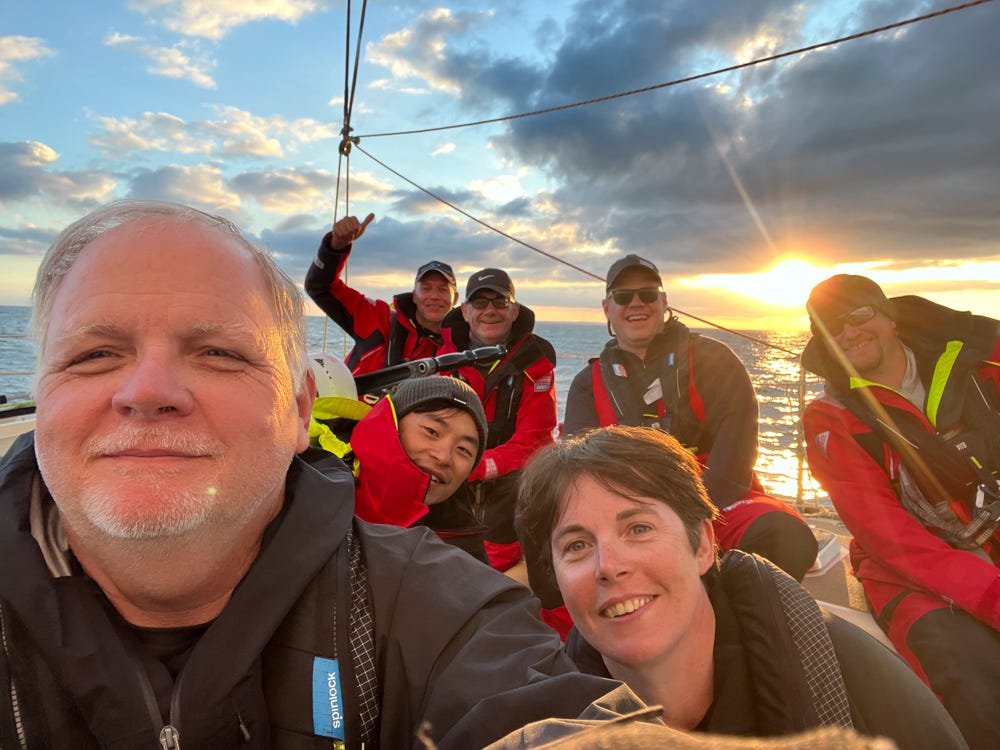
One moment stands out. In the pitch black night, with no lights to guide us and just five of us on deck, were able to tack the 68-foot training yacht by feel, voice, and trust. That’s when the training began proving itself—not just in what we learned, but in how we learned to rely on one another.
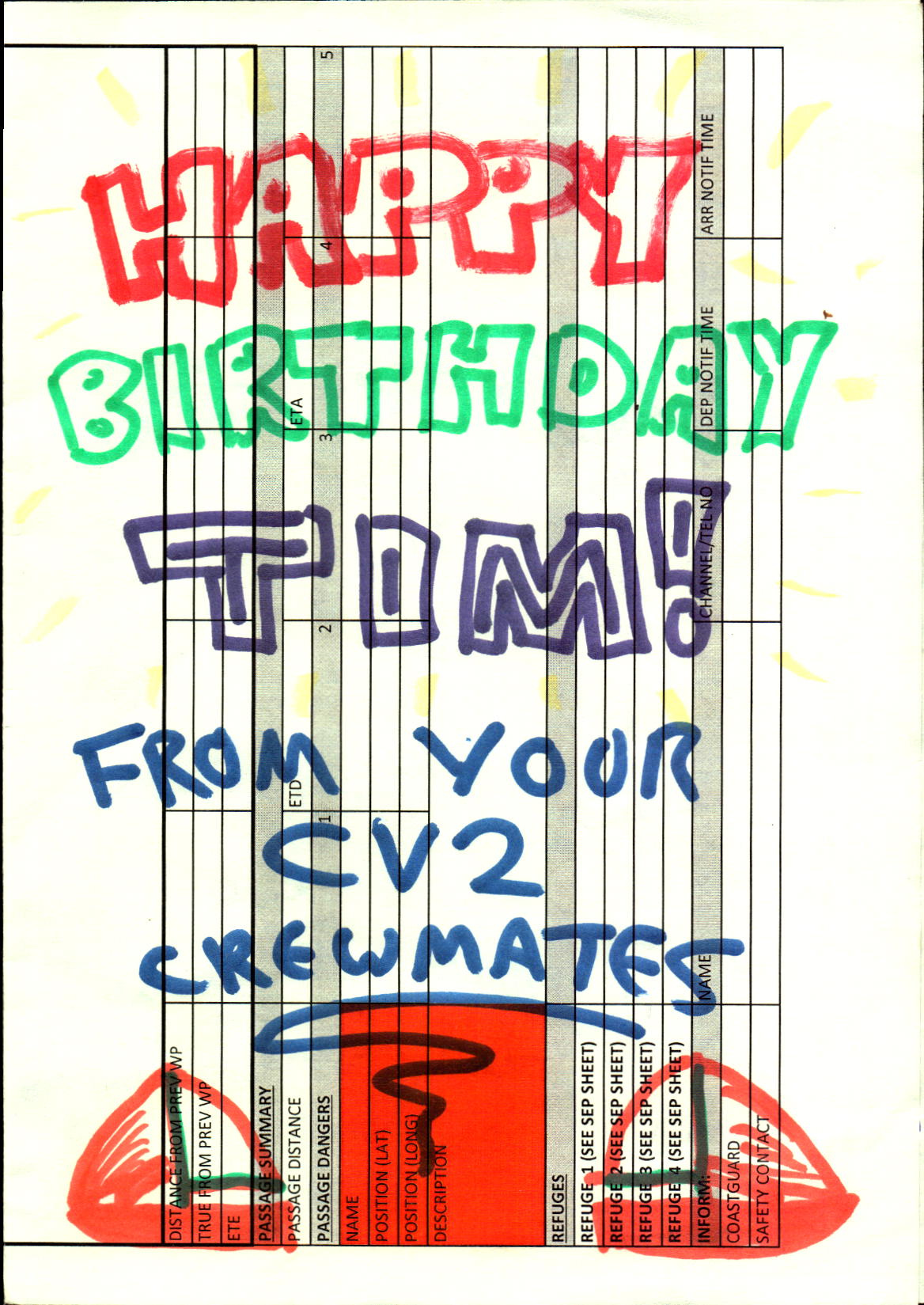
And as if that weren’t enough, I celebrated my birthday offshore on the final day of Level 2. The crew surprised me with an improvised “cake” built from a biscuit—or, as we say in the U.S., a cookie, topped with Nutella. It was a small thing, but out there, it felt big. A thoughtful gesture that made a windless offshore afternoon feel unforgettable.
Level 3: Becoming Race-Ready
“We’re not just crew now. We’re a team.”
Level 3 turned up the heat.
This was my first time sailing on a Clipper 70—the same class of yacht we’ll race around the world. The scale, the power, and the responsiveness of the boat demanded more from all of us. The training was intense, and for good reason: this is where we started preparing not just to sail, but to race.
The people on board were solid—focused, capable, and eager to push themselves. We spent a lot of time working through spinnaker theory and drills: setting, trimming, dropping, and repacking sails again and again until it started to feel like second nature. Nothing quite matches the mix of chaos and coordination it takes to fly a spinnaker well.
And of course, there were moments of humor that cut through the pressure. One quote from our skipper has stuck with me ever since: “Two useless things on a boat are a lawnmower and a naval officer.” As a Navy veteran, I had no choice but to laugh—and being that I was enlisted, I had to agree!
Still, I came away from Level 3 with a realization: in all the intensity and new learning, some of the basics from earlier training had started to slip. So before heading into Level 4, I made a point to refocus—brushing up on my nautical terms and knot tying, making sure the fundamentals were solid before stepping into the final phase of training.
Crew Allocation: From Trainee to Teammate
Before heading home from the UK, I attended Crew Allocation—an event that feels like a cross between a reunion, a draft day, and a celebration of possibility.
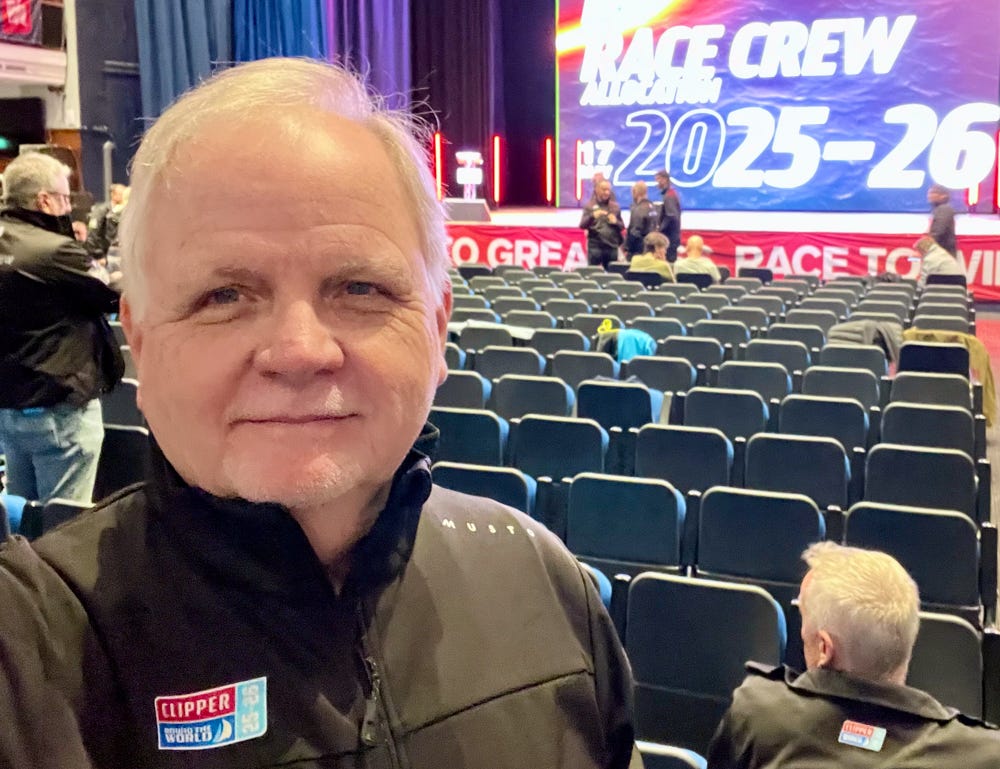
I sat with a group of familiar faces from training, and as the announcements rolled out, four of our wristbands lit up together. We had been selected to sail with Team Angela and Amy aboard CV21—the yacht soon to be branded “Power of Seattle Sports.” In a moment, months of anonymous drills and shared hardship turned into something more tangible: a team with a leader, a boat, and a mission.
Our skipper and first mate struck me right away as a strong duo—confident, approachable, and already showing the leadership style we’ll come to rely on. I didn’t know many of my future crewmates yet, but to my surprise and delight, I discovered I’d been assigned to the same team as someone I’d met a year earlier during the Clipper 2023–24 fleet’s visit to Washington, D.C. We’d struck up a friendship then, and now we’d be racing across the Southern Ocean together.
As the crew and skipper and brand came together, the race felt closer than ever.
Level 4: The Final Rehearsal
“It’s a dress rehearsal. And it feels real.”
My skipper. My team. My boat. My gosh.
Level 4 wasn’t just another training—this time, it was personal. I was finally sailing with my actual race team, aboard CV21, under the leadership of the skipper and mate I’d soon be crossing oceans with. And Amy, our first mate, wasted no time setting the tone. She reintroduced herself to me in the cockpit with a big smile, a glint in her eye, and the unforgettable words:
“Tim… we are going to sail around the world together!”
Yes. Yes, we are.
But despite the excitement, I had a harder time finding my way into the rhythm of this team—maybe because I got seasick early on. I had brought prescription patches, but in the day leading up to training I found they wouldn’t stick properly, so I shrugged it off, thinking, “I’ll be fine.”
I wasn’t.
I was seriously seasick—flat in a bunk for two solid days, and then sluggish for another. I was one of five who went down, but I stayed down the longest. Physically, it was rough. But knowing I was leaving my watch short-handed weighed heavily on me. I felt like I was letting my team down just when I wanted most to show I belonged.
Once again, the crew rallied. They made sure those who were sick we were cared for, hydrated, checked on. That kind of support is what turns a group of sailors into a team.
Once I started feeling better, everything began to click. I got my footing—literally and figuratively. One night on watch, we were joined by a pod of dolphins—dozens of them—darting through dark water under the foggy night. It was surreal, a moment of beauty that made the days of nausea fade.
We ended Level 4 with a training race. My team came in second—close enough to taste victory, and good enough to know we’re a capable crew, but also aware our boat had recently been out of the water for branding, so we had the second cleanest hull in the fleet (something a friend who was on the third place boat reminded me of at the pub later). This is matched fleet racing, little things like how clean your hull is matter. But still, this is a good team and I’m finding my fit.
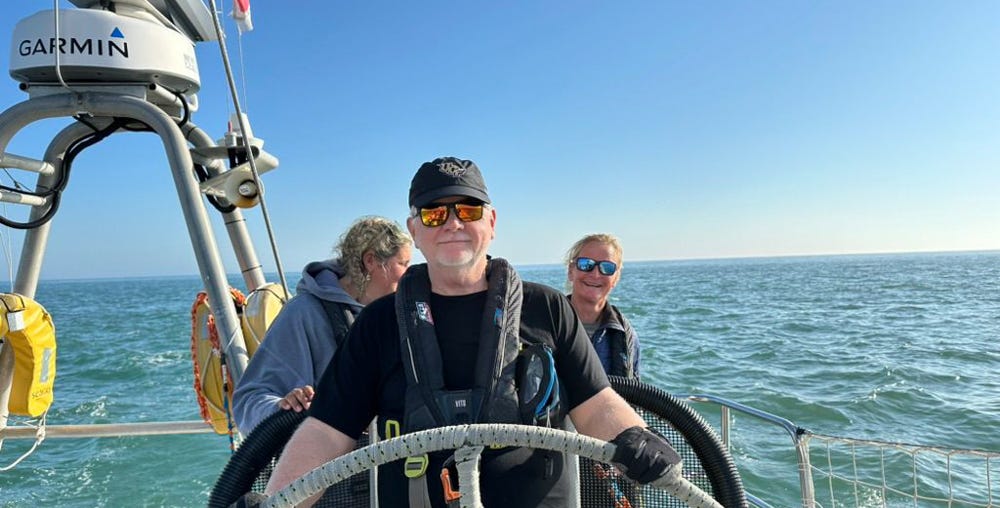
Perhaps the most meaningful moment came as I stood behind the helm near the end of our race. With gentle coaching from Skipper and Mate, for the first time, instead of having to think about it, I could really feel the boat. The Clipper 70—this powerful yacht with its massive sails—told me what she wanted through the helm and I replied my wishes with a light touch of my fingers. She was subtle, alive, and listening. I have a long way to go before I’ll feel truly competent, but in that moment, I began to believe that I’ll get there.
Soon, we will sail.
Sailing for a Cause
This journey isn’t just about the race—it’s also about raising support for something deeply personal. As I train and prepare to sail around the world, I’m also fundraising for The Preston Robert Tisch Brain Tumor Center at Duke University, in memory of my brother-in-law Bob. Your support helps fuel life-changing research in the fight against brain cancer.
If you’d like to join me in this cause, you can follow me, learn more or donate here:
👉 tintypetim.com/